
Peptide Dosing Calculator
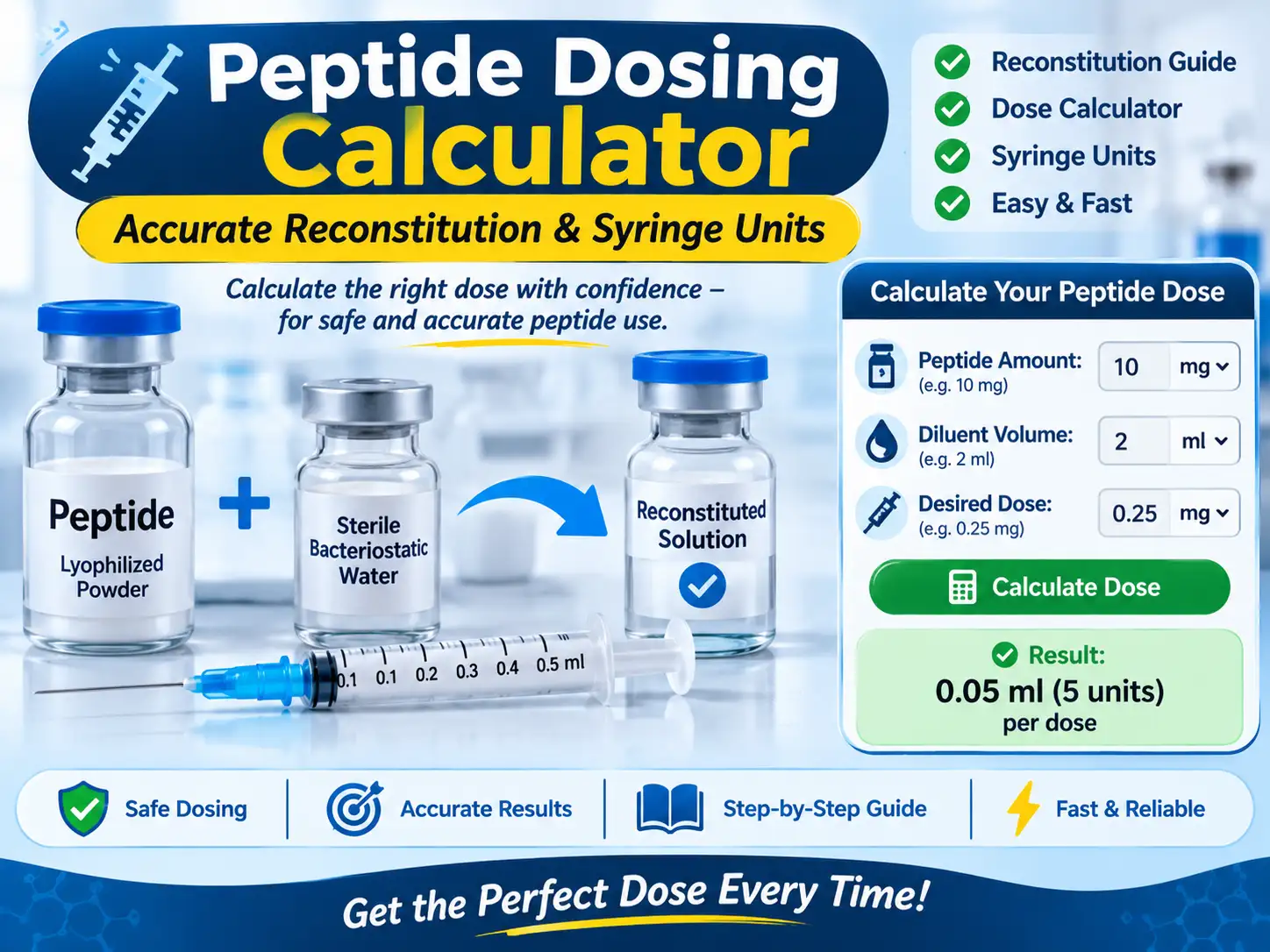
One of the most important parts of using research peptides is knowing how to use a peptide dosing calculator. This allows researchers, clinicians and laboratory workers to accurately determine how much liquid they should put into their syringe. Use our free tool below for precise reconstitution calculations.
Calculation Results
In this article, we will explain how a peptide calculator works, how to work out the math and how to use out free online tool to avoid making any expensive mistakes. We will also answer some of the common questions people ask about mg conversions and how to work out the right dose.
What is a Peptide Dosage Calculator?
A peptide dosage calculator is a digital tool that helps you work out the complex math needed when reconstituting your peptides. Most research peptides will come in a dry form. To use them in liquid form you will need to add some liquid (usually bacteriostatic water). This process is called reconstitution.
The calculator requires you to input;
- Amount of Peptide (mg)
- Amount of Water (mL)
- Your Target Dose (mcg/mg)
Upon entering this information into the calculator the tool will automatically tell you how much units you need to draw into your syringe (usually U-100 insulin syringe). This means you can avoid making any human errors which could cause under/over dosing.
Why Use a Peptide Calculator?
Working out the maths can be confusing. If you've ever looked up how to calculate peptide doses you'll know that it's easy to confuse mg and mcg.
Using a peptide calculator means;
- No maths errors: Being off by a couple of decimal points can greatly change your concentration.
- Save time: No maths required, instant results.
- Accuracy: Accurate measurements are important when working with peptides for research.
- Easy to use: Complex ratios made simple with 'fill to this line' instructions.
How to Work Out Reconstitution (Peptide Calculator Mg)
Understanding how the maths works will help you verify that your results are correct. The main formula for a peptide dosage calculator is the concentration.
Concentration = Amount of Peptide (mg) / Amount of Water (mL)
Once you have the concentration, you can work out how much to draw into your syringe.
Amount to Draw = Target Dose (mg/mcg) / Concentration (mg/mL)
As insulin syringes are measured in units (100 units = 1mL) you then need to convert your mL into units.
Example:
- Amount of Peptide = 5mg
- Amount of Water = 2mL
- Concentration = 5mg / 2mL = 2.5mg/mL
- Target Dose = 250mcg (0.25mg)
- Amount = 0.25mg / 2.5mg/mL = 0.1mL
- Units on your Syringe = 0.1mL × 100 = 10 units on your U-100 syringe.
If ever unsure, our peptide dosage calculator will quickly work this out for you.
How to Use Our Peptide Dosage Calculator
Our free peptide calculator is very easy to use. Just follow these steps.
- Input Amount of Peptide.
- Input Amount of Water.
- Input Target Dose. Usually you can toggle between mcg and mg.
- Select your Syringe Size.
- Hit calculate. The calculators will automatically show you the concentration, amount to draw and the units to pull.
What is a Biosynth Peptide Calculator?
You may see the term biosynth peptide calculator. Biosynth are a well known supplier of custom peptides and biochemicals. They have an automated quote generator to allow researchers to input their sequences and get a price.
This is mainly for ordering custom sequences but can be used interchangeably by some researchers. If you're trying to work out how much dosage of your peptide you have, our tool above will help you.
Common Errors
Even with a calculator it's easy to make mistakes;
- Mixing up mg and mcg: 1mg = 1,000mcg. Always double check your units.
- Incorrect amount of water: If you add 3mL of water rather than 2mL your concentration will change. Always work out your concentration first.
- Shaking your vial: Never shake your vial aggressively when reconstituting. Simply swirl gently.
- Forgetting to store in the fridge: Most reconstituted peptides should be stored in the fridge.
Tips for Safety and Storing
- Use bacteriostatic water: If you're using a multi-dose vial you should always use bacteriostatic water. Sterile water doesn't contain a preservative and bacteriostatic water does.
- Store your peptides: Lyophilised (dry) peptides should be stored in the freezer/refrigerator. Once reconstituted they should be stored in the refrigerator.
- Use a new syringe: Always use a new sterile syringe.
Conclusion
Whether you're an experienced researcher or just starting out, a reliable peptide dosage calculator is essential. It will ensure your reconstitution is correct, your maths is right and your research is replicable. Understanding the maths involved with the peptide calculator mg conversions and using our free tool will allow you to focus on your research.