
Winter's Formula Explained: Metabolic Acidosis Compensation
📅 January 1, 2025 | ⏱️ 8 min read | 📂 Medical
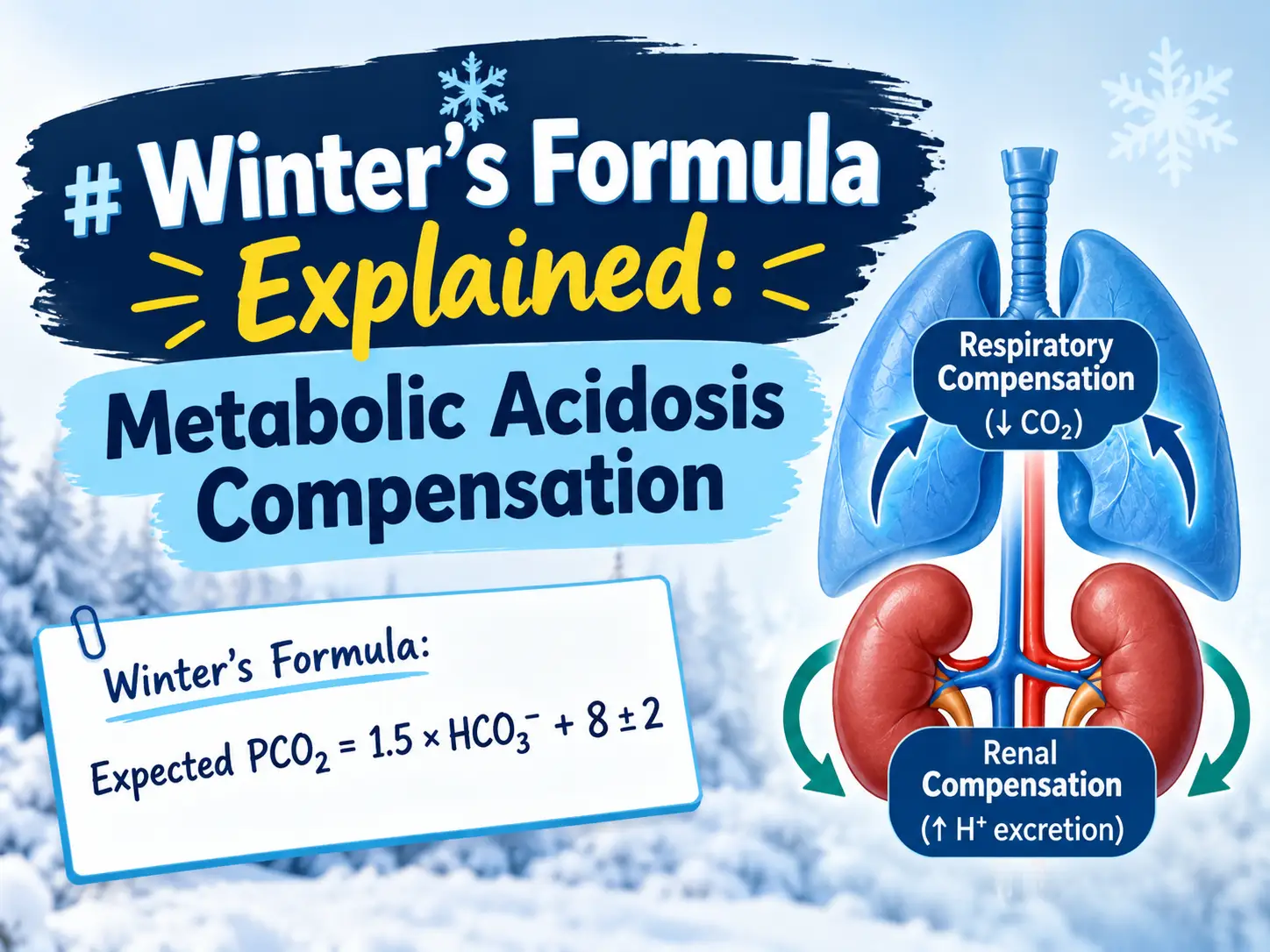
Winter's formula is one of the most valuable equations in clinical medicine, yet it is also one of the most misused. It allows clinicians, nurses, and medical students to evaluate whether patient's lungs are compensating appropriately for metabolic acidosis or if there is some more sinister process occurring beneath the surface. In this guide, we'll explain what is winter's formula, go over an easy-to-follow-steps guide on how to use it, and give plenty of clinically relevant examples.
To calculate the corrected calcium levels you can use our Corrected Calcium Calculator. And for other calculators visit the rest of our site.
What is Winter's formula?
Winter's formula (sometimes spelled Winters formula) is a mathematical formula that allows clinicians to estimate the expected PaCO2 (partial pressure of carbon dioxide in arterial blood) for a patient with metabolic acidosis. The formula is:
Expected PaCO₂ = 1.5 × HCO₃⁻ + 8 ± 2
Where:
- PaCO2 = partial pressure of carbon dioxide in arterial blood (mmHg)
- HCO3- = serum bicarbonate level (mEq/L)
- ± 2 = acceptable range (margin of error)
The formula was first described by Dr. Robert Winter in 1967 and has since been widely used in clinical practice. It has been proven to be incredibly useful in determining if the respiratory compensation for metabolic acidosis is appropriate or if there is some additional respiratory disorder that is contributing to the acid-base disturbance.
Why is this formula so interesting to clinicians?
When patients develop metabolic acidosis their bicarbonate levels drop and blood becomes more acidic. The body's natural response is to hyperventilate in an attempt to expel more carbon dioxide, however, how can we tell if the lungs are compensating sufficiently for the drop in pH? That's where winter's formula comes in.
Without a tool like winter's formula, clinicians would be forced to rely only on intuition to determine whether the patient is hyperventilating appropriately or not. However, by using this formula, clinicians can get an exact number to compare to, enabling them to come up with a more accurate diagnosis for mixed acid-base disorders.
How to use Winter's formula
Using Winter's formula is relatively straightforward. First, you'll need to obtain the patient's bicarbonate (HCO3-) level. This can be done by performing an arterial blood gas (ABG) or a basic metabolic panel (BMP). Then, plug this number into the following formula: Expected PaCO2 = 1.5 × HCO3 + 8 ± 2.
Finally, compare the calculated value to the actual PaCO2 level that was obtained during the ABG. You should see whether the measured value falls within the expected range. If it does - the compensation is appropriate, and if it doesn't, there is likely some additional respiratory disorder that is contributing to the acid-base disturbance.
The basics of acid/base disorders
Before delving deeper into winter's formula, it's important to have a basic understanding of acid/base disorders. In short, the body has a delicate acid/base balance that needs to be maintained within a very narrow range (7.35-7.45). When this balance is disrupted, acid/base disorders occur. There are four main types of acid/base disorders:
| Disorder | pH | HCO3 | PaCO2 |
|---|---|---|---|
| Metabolic acidosis | Low | Low | Low (compensatory) |
| Metabolic alkalosis | High | High | High (compensatory) |
| Respiratory acidosis | Low | High (compensatory) | High |
| Respiratory alkalosis | High | Low (compensatory) | Low |
In metabolic acidosis the main issue is low bicarbonate levels. The body's natural compensation is to hyperventilate in order to expel more CO2 and lower the PaCO2. Winter's formula is used to estimate the expected drop in PaCO2.
The basics of physiology
Physiologically speaking, metabolism is the process of breaking down food and other molecules to create energy. In order to do this, the body must produce carbon dioxide as a waste product. This CO2 is then expelled from the lungs during exhalation. However, when the body is unable to get rid of the CO2 efficiently it can lead to respiratory acidosis.
The same principle applies to metabolic acidosis. When the body produces too much acid or loses too much bicarbonate, the pH of the blood drops below 7.35. As mentioned previously, the body's natural response is to hyperventilate in order to expel more CO2. This lowers the PaCO2 which in turn helps to raise the pH back towards normal levels. Winter's formula focuses on this part of the compensation process because it is the fastest and easiest to measure using an ABG.
By understanding the physiology behind metabolic acidosis, clinicians can better understand why winter's formula works the way it does.
A clinical example of winter's formula
Let's take a look at a realistic example to see how winter's formula can be used in a clinical setting.
Example 1:
A patient has a bicarbonate level (HCO3) of 15 mEq/L and an arterial blood gas (ABG) reveals a PaCO2 of 30 mmHg.
Step 1: Expected PaCO₂ = 1.5 × 15 + 8 ± 2
Step 2: Expected PaCO₂ = 22.5 + 8 ± 2 = 30.5 ± 2
Step 3: Expected range = 28.5 to 32.5 mmHg
Step 4: The measured PaCO2 of 30 mmHg is right in the middle of the expected range, which means the compensation is appropriate and there is no additional respiratory disorder.
Example 2:
A patient has a bicarbonate level (HCO3) of 15 mEq/L and an arterial blood gas (ABG) reveals a PaCO2 of 45 mmHg.
Step 1: Expected range = 28.5 to 32.5 mmHg
Step 2: The measured PaCO2 of 45 mmHg is significantly higher than the expected range, which means the compensation is inappropriate and there is likely an additional respiratory acidosis present.
Example 3:
A patient has a bicarbonate level (HCO3) of 15 mEq/L and an arterial blood gas (ABG) reveals a PaCO2 of 22 mmHg.
Step 1: Expected range = 28.5 to 32.5 mmHg
Step 2: The measured PaCO2 of 22 mmHg is significantly lower than the expected range, which means the compensation is inappropriate and there is likely an additional respiratory alkalosis present.
Another clinical example
A 45-year-old patient with poorly controlled diabetes presents to the ER with nausea, vomiting, and confusion. Her arterial blood gas (ABG) reveals a pH of 7.20, bicarbonate of 10 mEq/L, and PaCO2 of 28 mmHg.
Using winter's formula: Expected PaCO₂ = 1.5 × 10 + 8 ± 2 = 15 + 8 ± 2 = 23 ± 2 = 21 to 25 mmHg expected range
The measured PaCO2 of 28 mmHg is higher than the expected range, which means the compensation is inappropriate and there is likely an additional respiratory acidosis present. This could be due to fatigue or respiratory muscle weakness.
Normal values
Before we finish, let's take a look at some normal values:
| Parameter | Normal range |
|---|---|
| pH | 7.35 - 7.45 |
| PaCO2 | 35 - 45 mmHg |
| HCO3- | 22 - 26 mEq/L |
| PaO2 | 80 - 100 mmHg |
Clinical utility of winter's formula
Winter's formula is a valuable tool in clinical medicine. It can be used to:
- Determine if patient's lungs are compensating appropriately for metabolic acidosis
- Identify mixed acid-base disorders
- Guide therapeutic interventions
- Monitor response to treatment
By understanding the formula and knowing what to look for, clinicians can use it to improve their diagnosis and treatment of acid/base disorders.
When not to use winter's formula
Winter's formula should not be used in patients with metabolic alkalosis. It should also be used with caution in patients with chronic respiratory disease such as COPD, as the formula may not account for their baseline PaCO2 levels.
Limitations of winter's formula
Winter's formula has several limitations, including:
- It is not applicable to chronic respiratory disorders
- It is not applicable to metabolic alkalosis
- It is based on a single measurement (ABG)
- It should not be used as a substitute for clinical evaluation
Tips for medical students and residents
For medical students and residents, winter's formula can be intimidating at first, but once you get the hang of it, it's actually quite simple. Here are a few tips:
- Remember the formula: 1.5 × HCO3 + 8 ± 2 is short and easy to remember.
- Practice makes perfect: Use the formula on different ABG values until you feel comfortable with it.
- Context is everything: Don't forget to take the whole picture into account when using the formula.
- Write it down: On exams, it's always a good idea to write out the formula and plug in the numbers to avoid mistakes.
- Understand the physiology: Knowing how the body works is key to understanding why the formula works the way it does.
Common mistakes
Even the most experienced clinicians can make mistakes with winter's formula. Here are a few common ones:
- Forgetting the ± 2 range
- Using the wrong bicarbonate value
- Applying the formula to alkalosis
- Ignoring the clinical picture
- Misreading units
Winter's formula vs. other formulae
In addition to winter's formula, there are other formulae that can be used to estimate the expected PaCO2 for different types of acid/base disorders. For metabolic alkalosis the formula is: Expected PaCO2 = 0.7 × HCO3 + 21 ± 2. In acute respiratory acidosis PaCO2 increases by approximately 10 mmHg for every 10 mEq/L rise in bicarbonate. In chronic respiratory acidosis the rise in PaCO2 is approximately 4 mmHg for every 10 mEq/L rise in bicarbonate.