
Does Muscle Weigh More Than Fat? The Truth Explained
📅 January 1, 2026 | ⏱️ 8 min read | 📂 Fitness
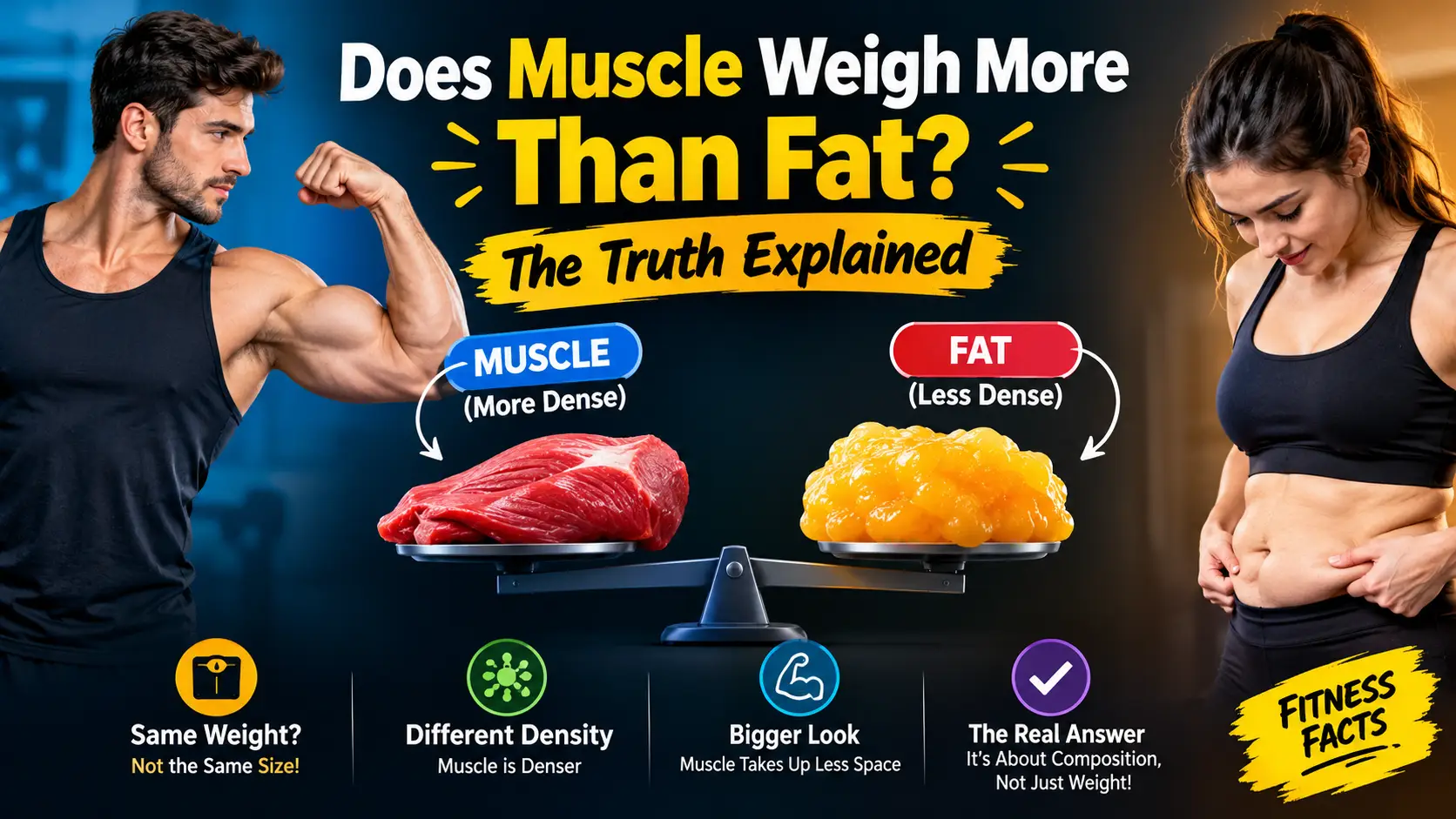
Does muscle weigh more than fat? This is one of the most common questions in fitness and the answer might surprise you. Yes, a pound of muscle and a pound of fat weigh the exact same- one pound. However, muscle is much denser than fat which means one pound of muscle takes up significantly less space than one pound of fat. This is why two people can be the same weight on the scale but look completely different on the outside. It also explains why your weight on the scale is not necessarily telling you the whole truth about your progress if you're going to the gym to build muscle and burn fat at the same time.
This article will explain everything you need to know about the differences between muscle and fat, bust myths, and help you understand how to track your progress.
The Simple Truth: Muscle vs Fat Density
Let's start with the easy stuff. A pound of muscle and a pound of fat both weigh exactly 16 ounces. However, the density in muscle is higher than the density in fat, meaning that one pound of muscle takes up less space than one pound of fat. To put this into perspective, imagine having a pound of feathers and a pound of bricks. The bricks would be denser than the feathers meaning that a pound of bricks would take up less space than a pound of feathers.
Muscle vs Fat: Everything You Need to Know
| Muscle | Fat |
|---|---|
| Denser than fat, takes up less space for the same weight | Takes up more space per weight |
| Increases your RMR and helps you burn more calories at rest | Decreases your RMR and your ability to burn calories |
| Is healthy, increases your metabolism | Is unhealthy, decreases your metabolism |
| Makes you look toned | Makes you look soft/fatty |
| Burns more calories while at rest | Burns less calories while at rest |
Why Muscle is Great for Burning Calories at Rest (RMR)
Muscle is amazing because it keeps you burning calories even when you're sedentary. Fat is the opposite, and it decreases your metabolism. According to many studies, one pound of muscle burns approximately six calories per day, while one pound of fat burns two calories per day. That's a small difference, but it adds up.
Even more important is the fact that building muscle has a huge impact on your RMR and the amount of calories you burn at rest, especially when compared to the calories you burn during your workout.
For example, if you do a bench press and you burn around seventy calories doing the actual exercise. If you're not eating properly, those calories might as well be coming right out of your muscles. In other words, you need food (calories) to do the bench press- and the higher your RMR, the more food you need to eat to keep your muscles healthy and strong.
Muscle vs Fat: Myths Explained
Muscle turns into fat if you stop working out
This is one of the most common myths in the fitness industry and it's completely false. Muscle and fat are two completely different tissues and they don't mix. If you stop working out you might experience a decrease in your muscle mass (muscle atrophy) and an increase in your body fat.
So while muscle doesn't actually turn into fat, when you stop exercising both of these tissues can change.
Muscle memory helps you gain muscle fast
One of the most interesting things about muscle growth is the fact that if you've had muscle in the past it's much easier to gain muscle in the future. This is called muscle memory and it's the reason why most bodybuilders cut weight during the off-season and then bulk up quickly when the competition season approaches.
Gaining muscle mass at an accelerated rate is possible once you've gained, lost, and maintained muscle mass before. In other words, muscle memory makes it easier to gain muscle if you've already been training for a while.
How to Lose Fat and Gain Muscle at the Same Time (Body Recomposition)
Losing fat and gaining muscle mass at the same time is known as body recomposition and it's much harder than simply bulking or cutting weight. However, it's absolutely possible for beginners, people who have been inactive for a while, and people with higher body fat percentages. Here are some useful tips:
- Focus on strength training
- Eat enough protein
- Eat more on training days and less on rest days
- Be patient and set realistic expectations
- Get enough sleep
Use our calorie calculator to estimate how many calories you need to eat per day to maintain your weight.
How to Measure Your Body Fat Percentage
While there are many ways to calculate your body fat percentage, the most popular and accurate one uses the circumference method (tape measure).
How much fat can I lose?
Using the Army body fat calculator is one of the best ways to see if you're on track to meet your body composition goals.
Does the scale lie?
Muscle weighs more than fat by density, but they both weigh the same per pound. You can't really tell if you're gaining muscle and losing fat by simply looking at the scale. This is why you should track your body fat percentage (using our army body fat calculator), measurements, and how your clothes fit. If you're strength training, your muscle mass will increase, and your body fat will decrease. If your body fat is decreasing, it's safe to assume that you're still losing weight even if your weight on the scale isn't changing.
How does my body weight change as I lose fat and gain muscle?
As mentioned above, you can't really tell if you're gaining muscle and losing fat by simply looking at the scale. Body weight is a lagging indicator, and there are more useful ways to track your progress. You need to use a combination of body fat calculators, measurements, and personal experience (how your clothes fit) to determine whether you're making progress.
Muscle vs Fat: The Full Comparison
| Muscle | Fat |
|---|---|
| Denser than fat, takes up less space per weight | Takes up more space per weight |
| Healthy tissue | Unhealthy tissue |
| Increases your RMR | Decreases your RMR |
| Burns more calories at rest | Burns fewer calories at rest |
| Helps you lose weight and build muscle mass | Prevents you from losing weight and gaining muscle mass |
| Make you look stronger | Make you look soft/fatty |
The Truth About "Skinny Fat"
"Skinny fat" is a condition in which a person has a healthy weight but an unhealthy amount of body fat and a low amount of muscle mass. This often happens when people restrict calories without increasing their muscle mass. In other words, a person looks skinny, but they have a high percentage of body fat.
People who are skinny fat usually look healthy on the outside, but they have many of the same risks as people who are overweight. The good news is that the condition is treatable and it's not permanent. All you have to do is increase your muscle mass in order to reduce your body fat percentage.
How to Measure Your Body Fat Percentage at Home
There are several ways to measure your body fat percentage at home. The easiest and cheapest option is to use the circumference method (tape measure), but if you want more accuracy you can go for the DEXA scan or the hydrostatic weighing method.
- DEXA scan
- Hydrostatic weighing
The Truth About Losing Weight and Gaining Muscle at the Same Time (Body Recomposition)
As mentioned above, it's possible to lose body fat and gain muscle mass at the same time. This is called body recomposition and it's much harder than simply bulking or cutting. However, it's absolutely possible for beginners, people who have been inactive for a while, and people with higher body fat percentages. Here are some useful tips:
- Focus on strength training
- Eat enough protein
- Eat more on training days and less on rest days
- Be patient and set realistic expectations
- Get enough sleep
Use our calorie calculator to estimate how many calories you need to eat per day to maintain your weight.
Related Tools
Related Articles
- Saturated vs Unsaturated Fats
- How to Measure Waist and Hips Accurately
- Army AFT Standard
- Lean Bulk Guide: How to Gain Muscle Without Fat