
Rule of Nines for Burns: How to Estimate Burn Area
📅 January 1, 2026 | ⏱️ 9 min read | 📂 Medical
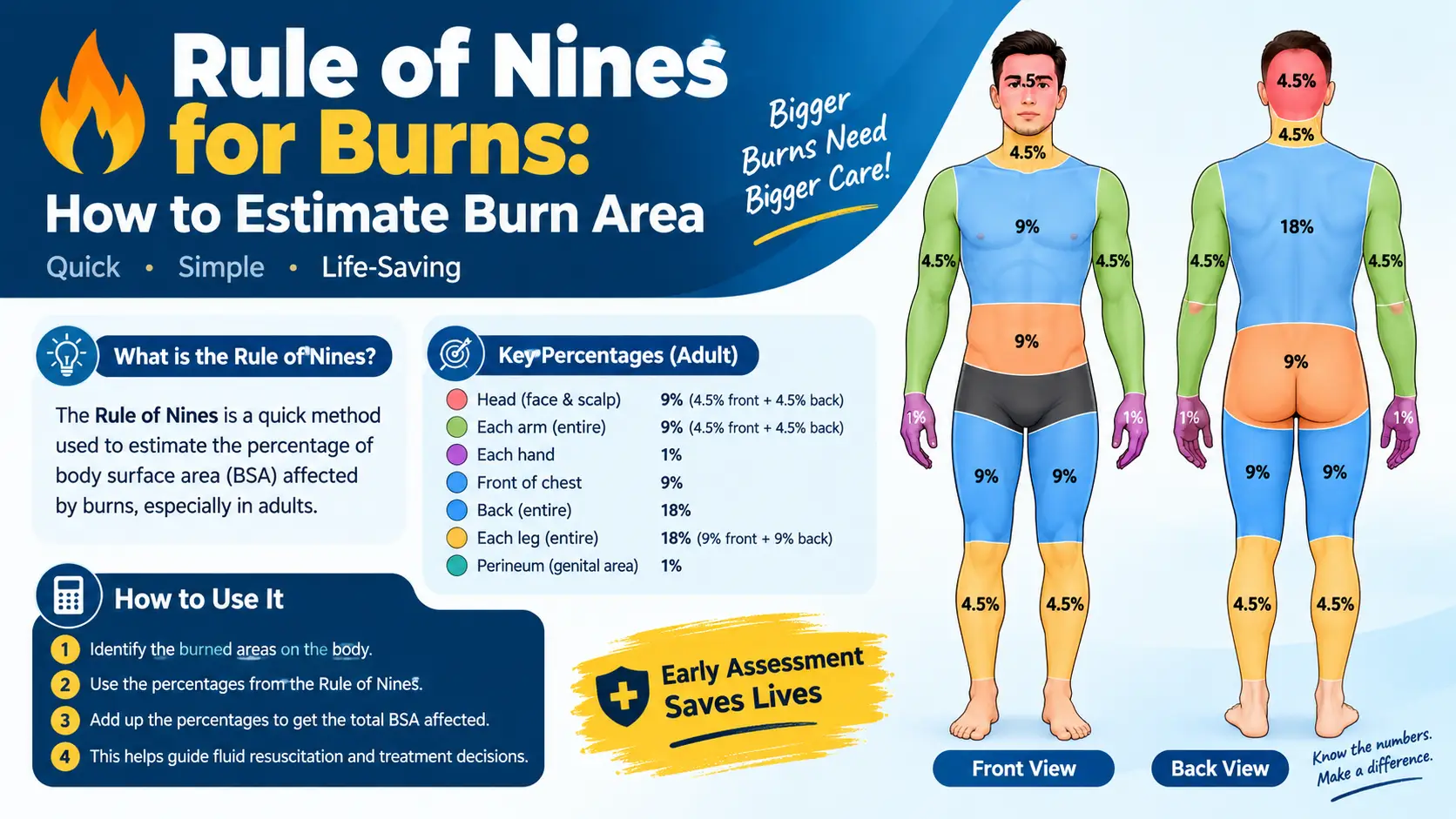
The Rule of Nines is a quick and handy method for calculating the amount of tissue damaged in a burn. This helps medical professionals to determine the severity of the burn and take appropriate action. In this article we will explain the Rule of Nines clearly show charts for adults and children and give examples of its use.
What is the Rule of Nines?
The Rule of Nines is a way to divide the body into regions that each account for approximately 9% or multiples of 9% of the body. By summing up the percentages of the regions affected by burns it is possible to quickly determine the amount of burn injury. This method is useful because it is quick and easy to remember.
The Rule of Nines is most accurate for calculating burns in adults. For children the calculation is adjusted to account for their larger heads relative to their bodies and shorter legs. We will illustrate both methods in this article.
Rule of Nines Chart for Adults
Here is the division of the body for adults according to the Rule of Nines:
| Body Part | Percentage (Adults) |
|---|---|
| Head and neck | 9% |
| Each arm (including hand) | 9% each (total 18%) |
| Each leg (including foot) | 18% each (total 36%) |
| Anterior trunk (front of torso) | 18% |
| Posterior trunk (back of torso) | 18% |
| Perineum (groin area) | 1% |
Note: The percentages sum up to 100% (9 + 18 + 36 + 18 + 18 + 1 = 100).
Rule of Nines Chart for Children
For babies and young children the percentages are adjusted to account for their physical characteristics. Here is the division of the body:
| Body Part | Percentage (Children) |
|---|---|
| Head and neck | 18% |
| Each arm (including hand) | 9% each (total 18%) |
| Each leg (including foot) | 14% each ( 28%) |
| Anterior trunk | 18% |
| Posterior trunk | 18% |
| Perineum | 1% |
Note: The percentages sum up to 100% (18 + 18 + 28 + 18 + 18 + 1 = 101. The rule is approximate and rounded).
How to Use the Rule of Nines
Using the Rule of Nines is simple. Simply follow these steps:
- Examine the burn: Identify the regions of the body that have been affected by the burn and take note of those that have not. Only degree and third-degree burns should be considered first-degree burns such as sunburn are not included.
- Assign percentages: Using the charts calculate the percentage of the body that is affected. For example if the entire left arm is burned that is 9%.
- Sum percentages: Add up the percentages for all of the affected regions to get a total.
- Apply results: Use the total to determine the severity of the burn and the course of treatment such as calculating fluid needs with the Parkland formula.
Examples
Let us examine some examples to see how the Rule of Nines works in practice.
Example 1: Adult with Burn on the Front and One Arm
A 35-year-old man has burns on the front of his body and in one of his arms. Using the Rule of Nines for adults:
- Front of body: 18%
- One arm: 9%
- Total: 27%
This is a burn and appropriate treatment should be administered.
Example 2: Child with Burn on the Head and One Leg
A 5-year-old child has burns on the head and one of their legs. Using the Rule of Nines for children:
- Head: 18%
- One leg: 14%
- Total: 32%
This is a burn and appropriate treatment should be given.
Why the Rule of Nines is Important
The Rule of Nines is a practical tool that has several important applications. Here are some of them:
- Fluids: Burn victims often require fluid therapy. The amount of fluid is calculated using the Parkland formula which depends on the TBSA %.
- Transfers: When the TBSA % is than 20% in adults and 10% in children the patient needs to be transferred to a specialized burn center.
- Outcome: The severity of the burn influences the prognosis and course of treatment.
- Triage: During emergency situations the Rule of Nines helps to prioritize patients based on the severity of their burns.
Limitations
While the Rule of Nines is a useful tool it has some limitations:
- Not for children: An adjusted version of the Rule of Nines should be used for children.
- Not for people: As people have different body types the Rule of Nines may give inaccurate results.
- Not for burns: The Rule of Nines is not appropriate for calculating the surface area of burns. Instead the Palm Method should be used.
- Requires assistance: The Rule of Nines should be used in conjunction with professional medical evaluation.
✨ Additional Information
The Rule of Nines was first introduced in 1944 by Dr. Alexander Wallace as a means of quickly determining the severity of a burn. Today this rule is used in conjunction with more modern methods to help medical professionals get a preliminary assessment.
The Difference Between Burn Types
The Rule of Nines only considers the damage to the tissue layers. Here is how to distinguish between types of burns:
- degree: Affects the top layer of the skin. Usually red and sore but not swollen and not counted toward the TBSA %.
- Second-degree: Affects layers of the skin. May also be painful and is counted toward the TBSA %.
- Third-degree: Affects all layers of the skin. Charred and potentially numb also counted toward the TBSA %.
What is the Lund-Browder Chart?
The Lund-Browder chart is a more accurate method for calculating the TBSA % in children. It uses percentages that vary depending on the age of the patient and is commonly used in specialized burn centers.
The Palm Method for Small Burns
When calculating the surface area of small burns the Palm Method is a better option. As the palm of a person's hand is approximately 1% of the total surface area of the body one can use it to measure burns.
What is Inhalation Injury?
When burned people are exposed to fires they may also sustain inhalation injuries. Signs of inhalation injury include black material in the mouth and a hoarse voice. This condition also requires treatment.