
Army AFT Standards: The ultimate guide to the AFT score chart
📅 October 3, 2026 | ⏱️ 12 min read | 📂 Army Fitness
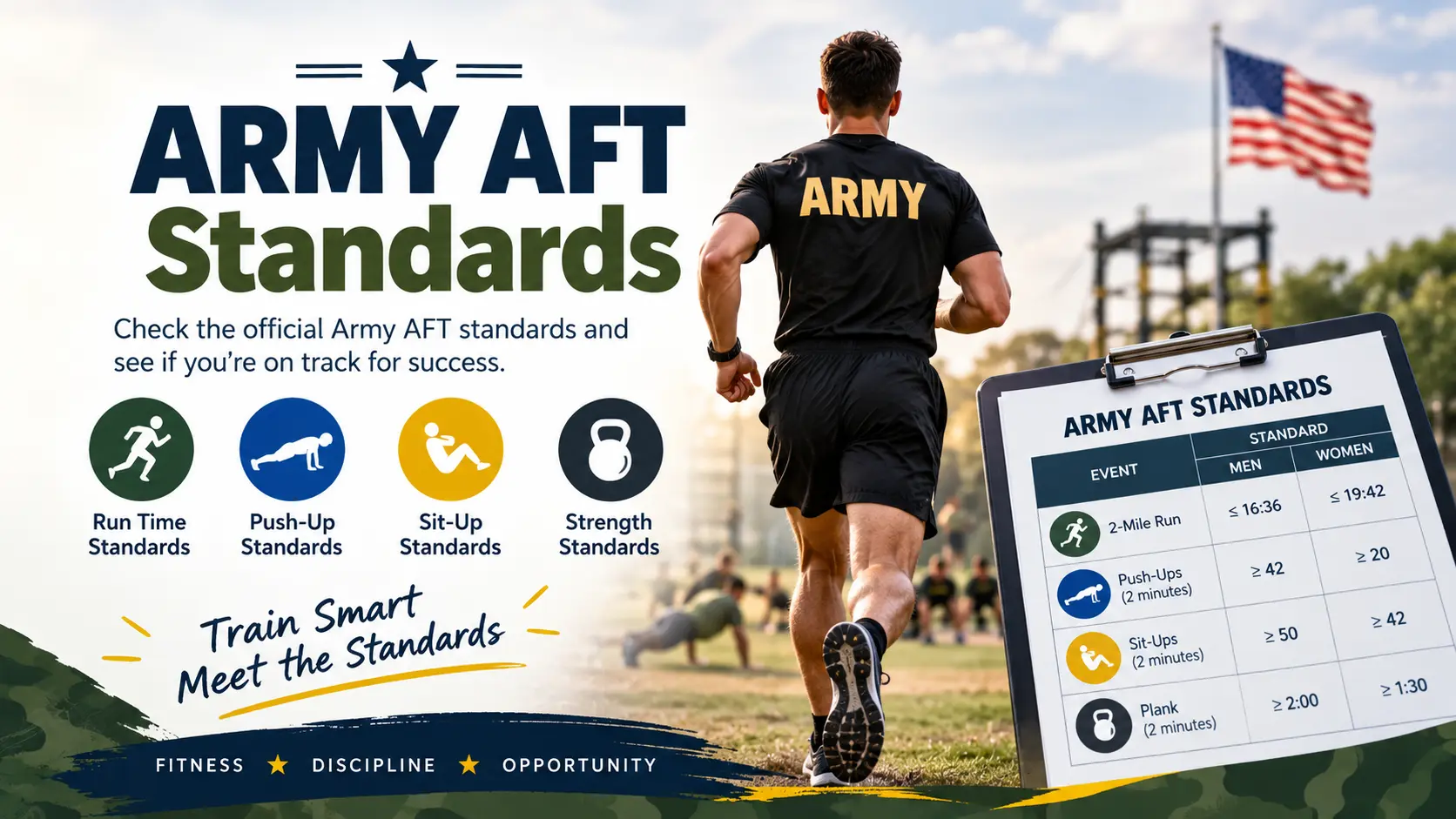
For every single soldier in the Army, the Army AFT standards are the ultimate measure of a fit soldier. The Army Fitness Test (AFT) is the requirement for every individual who is to serve in the military. Whether you are a newly enlisted recruit or an officer who needs to take the test for promotion purposes, it is of paramount importance that you understand the AFT standards.
What is the Army Fitness test?
The Army Fitness Test (AFT) is the updated version of the old Army Physical Fitness Test (APFT). The AFT aims to provide a more accurate and realistic assessment of a soldier's physical fitness. The old APFT used to have push-ups, sit-ups, and a 2-mile run for the fitness assessment, whereas the AFT is made up of more combat-specific tasks.
The AFT standards are strict, and a score of at least 60 points in each event is required to pass. The events include the Maximum deadlift, Standing power throw, Hand-release push-ups, Sprint-drag-carry, Leg tuck or plank, and a 2-mile run. You need to pass all the events to pass the AFT.
How to read the AFT score chart?
The AFT score chart is somewhat complicated, as it takes into account age and gender. It is important to understand how the AFT score chart works if you want to know what level of performance to strive for in each of the six fitness events.
First off, it should be noted that each event is scored individually and then combined for the final AFT score. According to the AFT standards, you need to score at least 60 points in each of the six events to pass the Army Fitness Test. The minimum possible score is therefore 360 points, and the maximum score is 600 points (60 points x 6 events).
Although just passing the Army AFT standards is important, there are certain military jobs and schools (such as the Ranger School) that require much higher passing scores. You should also note that the AFT score chart has different passing scores for different demographics.
How to prepare for the AFT?
Passing the AFT is never easy, but with adequate preparation, you can pass the test with flying colors. Since the AFT is focused on strength, power, and endurance, your training should be a mix of resistance training and conditioning.
However, it is important to note that the Army AFT standards have different requirements for each of the six events. Here are some of the most effective ways to prepare for the Army Fitness Test:
- Train for power: The Standing Power Throw is all about power, so make sure that you are incorporating medicine ball throws and plyometric exercises into your training program.
- Improve grip and core strength: The Sprint-drag-carry demands tremendous core and grip strength, so it is important that you incorporate farmer walks and hanging leg raises into your training.
- Focus on your deadlift: The Maximum deadlift is one of the most important lifts for the AFT, so make sure that you are practicing it consistently to improve your score.
- Train for a faster 2-Mile Run: Building aerobic endurance is crucial if you want to run a faster 2-mile. Try to incorporate some form of interval training and long slow distance runs into your training plan.
- Eat clean: If you want to improve your endurance and achieve a high score on the AFT, it is important to eat clean and get all of the necessary vitamins and minerals your body needs. If you want to know your body fat percentage, you can use our Army Body Fat Calculator.
Why the AFT was created
In the past, the APFT (old Army Physical Fitness Test) used to have three events that every soldier had to undertake – push-ups, sit-ups, and a 2-mile run. However, it was realized that this test wasn't an accurate assessment of a soldier's physical fitness because it did not take into account other components of fitness, such as power and speed.
That is why the APFT was replaced by the AFT, which has six fitness events (instead of three) and demands a higher level of fitness from soldiers. For example, you have to complete the Sprint-drag-carry in the AFT, which involves sprinting, dragging, and carrying weighted equipment – a task that is arguably much more realistic and challenging than the old 2-mile run.
The new AFT also requires a greater degree of muscular strength and endurance, as compared to the old APFT. This is evident in the Maximum deadlift and Standing power throw, which are two very demanding events. Finally, the AFT standards for the Leg tuck or Plank have been increased as well, which means that soldiers now have to hold a plank position for a much longer duration.
The new AFT also gives soldiers the option to either perform the Leg tuck or the Plank, which is a great incentive for those who find the Leg tuck very difficult. The Plank option is a test of isometric strength endurance, while the Leg tuck is a test of core strength and power endurance. It is important to note that the Plank option is much harder for those with shoulder issues, so it is best to practice your planks if you are considering this option.
How the AFT affects your Army career
As mentioned earlier, the minimum passing score for each Army AFT event is 60 points. This ultimately means that you need to score a minimum of 360 points on the Army AFT to pass it. However, if you want to attend schools such as the Airborne, Air Assault, and Ranger schools, you will need a much higher score than 360 points.
Furthermore, many Army jobs require a higher level of fitness, which means that you need a better score on the AFT. Therefore, it is always a good idea to score as high as you can on the Army Fitness Test.
Injuries related to the AFT
Because the AFT is significantly more challenging than the old APFT, there are now more injuries related to AFT training. The most common injuries associated with the AFT are lower back pain, shoulder pain, and hamstring strains.
Lower back pain is a fairly common injury among soldiers due to the high demands of the deadlift and the leg tuck. This can be avoided by maintaining good posture and practicing proper deadlift form.
On the other hand, Shoulder pain can also be very common, especially among soldiers who struggle with the hand-release push-ups and the standing medicine ball throw. As such, it is important to do some shoulder mobility drills to prevent any injuries during the AFT.
Hamstring strains are also very common among soldiers, especially due to the intense sprints during the sprint-drag-carry event. It is therefore important that you stretch your hamstrings properly before the AFT.