
Free Water Deficit Explained: Formula & Clinical Guide
📅 January 1 2025 | ⏱️ 7 min read | 📂 Medical
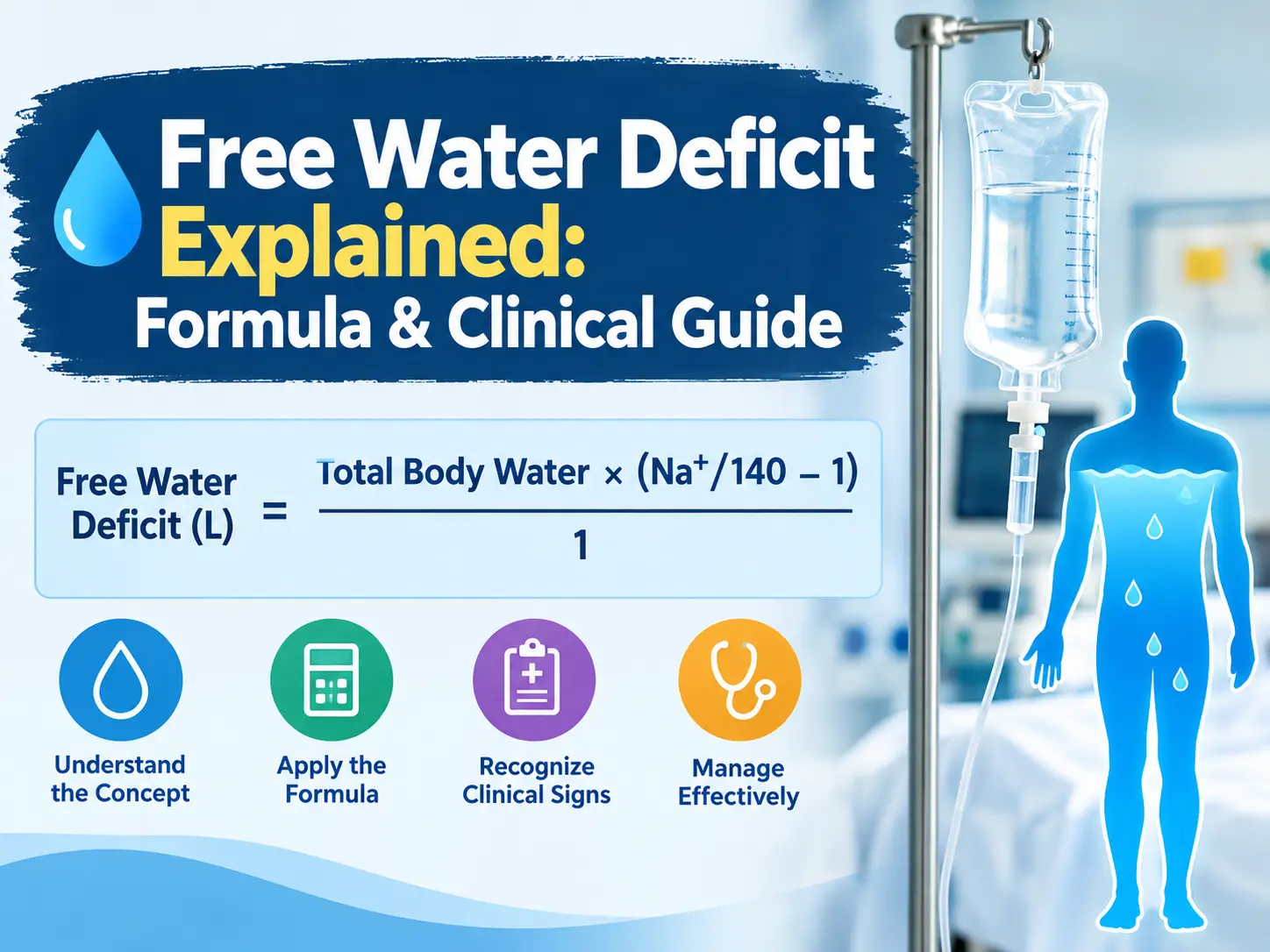
Free water deficit is the amount of water needed to fix a fluid imbalance in a patient with high sodium levels in the blood. High sodium levels in the blood can be caused by dehydration, much sodium or problems with the ability to feel thirsty. Free water deficit is a calculation in medical settings.
In this guide we'll explain what free water deficit is, the formula to calculate it how its used in practice and important safety tips. If you want to calculate your free water deficit now use our free Free Water Deficit Calculator.
What is Free Water Deficit?
Free water deficit is the amount of water needed to fix sodium levels in the blood. It is the sodium in the body compared to the amount of water. This calculation gives information about how much fluid needs to be added to safely lower high sodium levels.
High sodium levels in the blood often happen because of dehydration or much sodium. Free water deficit is used in settings to help plan how to replace fluids for patients with high sodium levels. It also helps prevent problems that can happen if sodium levels go down quickly.
The Free Water Deficit Formula
The formula for free water deficit is:
Free Water Deficit = Total Body Water × (Serum Sodium / 140 - 1)
Where Total Body Water = 0.6 × Weight (kg) for men and 0.5 × Weight (kg) for women
This formula estimates the amount of water that needs to be given to fix sodium levels. The number 140 represents the sodium level. If a patients sodium level is higher than 140 the patient has a free water deficit. If it is lower the patient has a free water excess.
How to Use the Free Water Deficit Calculator
Using our Free Water Deficit Calculator is simple.
- Choose your gender: Male or Female
- Enter your weight in kilograms: You'll need to convert pounds to kg if you're using lbs (1 kg = 2.2 lbs)
- Enter your serum sodium level: This will be a number indicating your serum sodium in mEq/L.
- Click "Calculate Free Water Deficit": Your estimated free water deficit will be displayed in liters.
Clinical Example
Lets go through an example to see how the free water deficit formula is used in practice:
Patient Details:
- Gender: Male
- Weight: 70 kg
- Serum Sodium: 155 mEq/L
Step 1: Calculate Total Body Water (TBW)
TBW = 0.6 × 70 = 42 L
Step 2: Calculate Free Water Deficit
Free Water Deficit = 42 × (155 / 140 - 1) = 42 × (1.107 - 1) = 42 × 0.107 = 4.5 L
Interpretation: The patient needs about 4.5 liters of water to fix the sodium levels. This water should be given slowly with checks of the sodium levels.
Normal Serum Sodium Levels
| Category | Serum Sodium (mEq/L) |
|---|---|
| Normal | 135 - 145 |
| Low | Below 135 |
| High | Above 145 |
The Importance of Free Water Deficit in Medicine
Free water deficit is very important in practice:
- Treating high sodium levels: Helps find out how much fluid is needed to lower high sodium levels.
- Checking for dehydration: Can help estimate how dehydrated a patient is when they can't drink water.
- Planning fluid replacement: Can help decide how much and how fast to give fluids to a dehydrated patient.
- Critical care: Helps manage balance and electrolyte problems in seriously ill patients.
- Diabetes insipidus: Patients with this condition often need water deficit calculations to manage their fluid needs.
Risks of Fixing Too Fast
Fixing sodium levels too quickly can be dangerous. The brain adapts to sodium levels by making special molecules. If the sodium levels drop fast water can rush into brain cells causing them to swell. This can lead to brain swelling, seizures and even death. The usual advice is to lower sodium levels by no than 10-12 mEq/L per day. Our Body Surface Area Calculator is another medical tool.
Why Does the Body Need Sodium and Water Balance?
Sodium is the electrolyte in the fluid around the body cells. It helps keep blood pressure right nerves working and muscles moving. The body keeps sodium and water balance through systems, including thirst, the renin-angiotensin-aldosterone system (RAAS) and antidiuretic hormone (ADH). When this balance is broken, either through losing much water or not getting enough high sodium levels can happen. The free water deficit calculation is a tool doctors use to find out how much water is missing so they can plan effective rehydration.
Common Causes of High Sodium Levels in Patients
High sodium levels are often grouped based on how they happened. The main types are:
- Volume high sodium: This type happens when both water and sodium are lost but more water is lost. This can happen from vomiting, diarrhea or fluid collecting in the body.
- Volume high sodium: This type happens when only water is lost and no sodium. This can happen with diabetes insipidus or in people who can't access water like patients.
- Volume high sodium: This type happens when theres too much sodium and no water loss. This can happen from giving much salt or from drinking too much salt.
Understanding the cause is important to choose the treatment (along with calculating the free water deficit).
Cerebral Edema: The Dangers of Fixing Too Fast
If high sodium levels develop more than 48 hours) the brain makes special molecules. These molecules help the brain cells keep their balance and prevent water from leaving. If the sodium levels drop fast water can rush into brain cells causing them to swell. This can cause brain swelling, seizures, coma and even death. Free water deficit should be fixed slowly (over 48 hours or more) with checks of the sodium levels (every 4-6 hours).
How is Free Water Deficit Used in the ICU?
In care units free water deficit is often calculated daily or even more often. Patients in the ICU can lose fluids (like from drains, fever or from a stoma). Might get certain fluids. The free water deficit helps decide what fluids to give and how fast. For example a patient with a free water deficit of 4.5 liters might get 5% dextrose in water (D5W) or normal saline (0.45% NaCl) depending on their fluid balance and other issues.
Free Water Deficit vs. Sodium Deficit
The free water deficit formula helps find out how much water is needed to fix sodium levels. In contrast if a patient has sodium levels doctors use the sodium deficit formula to find out how much sodium is needed to bring the level up safely. Both calculations are important in managing electrolytes. They deal with opposite problems. Our Free Water Deficit Calculator is for high sodium levels; for low sodium a different method is used.
Asked Questions About Free Water Deficit
Related Tools
Related Articles
- Winters Formula Explained: Metabolic Acidosis Compensation
- Calcium Adjusted Calculator Guide
- Rule of Nines for Burns