
Milliliters to grams Converter (ml to g & g to ml)
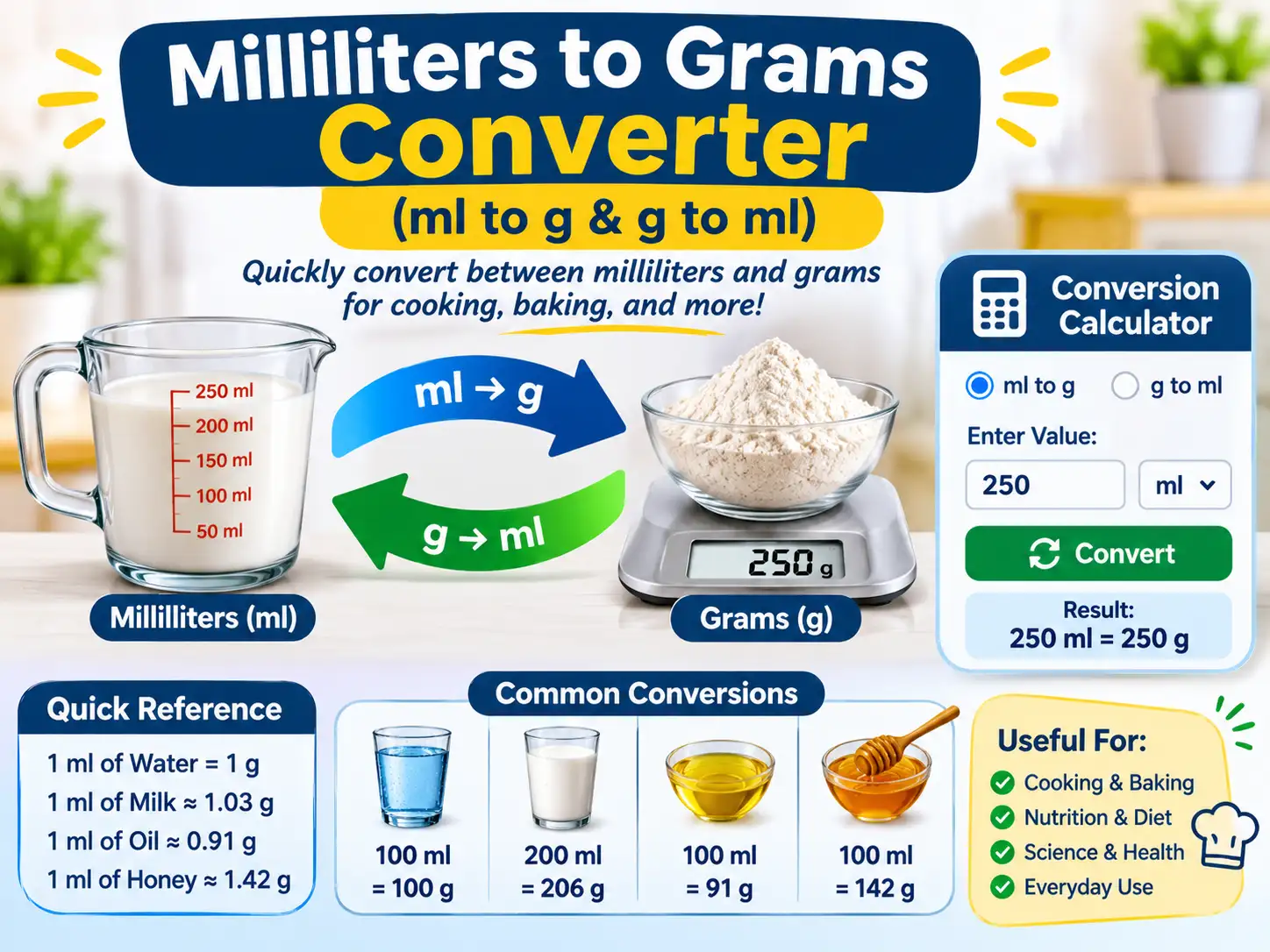
When you’re cooking, experimenting in science or measuring out medication you will inevitably need to know how to convert grams to milliliters. Unlike basic unit conversions such as meters to centimeters, it is not so straightforward. Use our free calculator below to instantly convert.
Conversion Result
Here at Guide, we’ll give you the formula for converting grams to milliliters, as well as a quick conversion chart so you can save time. We’ve also got a free interactive calculator which you can use to instantly convert from milliliters to grams and vice versa.
What is the difference between grams and milliliters?
Before we jump into the calculations, it is important to understand what you’re actually measuring. This is the most common area people get confused.
- Grams (g) – This is a unit of mass (or weight).
- Milliliters (ml) – This is a unit of volume.
As they are measuring different things 1gram does not always equal to 1milliliter. The conversion depends entirely on the density of the ingredient.
The Formula: Converting Grams to Milliliters (g to ml)
The formula to convert grams to milliliters is:
Volume (ml) = Mass (g) / Density (g/ml)
What is density?
Density is how much mass something has when compared to its volume. This shows how dense the matter is. For example, a cup of feathers would take up more space but would have a low mass, meaning it would have a low density. Whereas a cup of lead would take up the same amount of space but would have a high mass, therefore a high density.
Water has a density of exactly 1g/ml (at standard room temperature). Therefore when converting water, 1gram will equal 1milliliter.
The Formula: Converting Milliliters to Grams (ml to g)
If you want to convert the other way around, the formula is:
Mass (g) = Volume (ml) x Density (g/ml)
Don’t worry! Our calculator does this for you. Just choose the ingredient and it will calculate it for you.
Common Ingredient Conversion Chart (g to ml)
As the conversion depends on the density, we’ve put together a quick reference chart of common ingredients found in the kitchen. The values given below are approximate based on standard densities.
| Ingredient | Density (g/ml) | 1 Gram to ml | 100 Grams to ml | 1 ml to grams |
|---|---|---|---|---|
| Water | 1.00 | 1 ml | 100 ml | 1 g |
| Milk | 1.03 | 0.97 ml | 97 ml | 1.03 g |
| All Purpose Flour | 0.53 | 1.89 ml | 189 ml | 0.53 g |
| Granulated Sugar | 0.85 | 1.18 ml | 118 ml | 0.85 g |
| Honey | 1.42 | 0.70 ml | 70 ml | 1.42 g |
| Butter | 0.91 | 1.10 ml | 110 ml | 0.91 g |
| Cooking Oil | 0.92 | 1.09 ml | 109 ml | 0.92 g |
How many grams in milliliters?
One of the most common searches is “how many grams in milliliters?” The answer can vary depending on the substance. For example,
- 1 ml of water = 1 gram
- 1 ml of milk = 1.03 grams
- 1 ml of flour = 0.53 grams
- 1 ml of honey = 1.42 grams
If you’re ever unsure then always find out the density of the ingredient.
What about ml a gr?
Often when searching for keywords you may come across "ml a gr". This is a bit of a mix of languages/abbreviations. Or simply "g to ml" or "ml to g".
- g = grams
- ml = milliliters
- gr = Sometimes used as an abbreviation for grams.
No matter how you type it, the calculations are exactly the same!
Why would I need to convert milliliters to grams?
There are many reasons why you may need to convert milliliters to grams.
- Cooking and Baking – Many international recipes will use grams (weight) some will use milliliters (volume). You will need to convert to get the recipe right.
- Nutrition and Diet – Nutritional information varies between countries. Converting helps you keep track of your macros and calories.
- Medicine and Pharmacy – Many liquid medicines will use milliliters. However the active ingredient may be measured in milligrams/grams.
- Science and Chemistry – In the lab you will need to measure liquids and solids very accurately to ensure your experiments work.
- Beauty and Cosmetics – Many DIY skincare and cosmetics recipes will need precise measurements in both ml and grams.
How to use our calculator
Our grams to milliliters converter is quick and accurate. All you need to do is:
- Choose the direction – Choose whether you want to convert Grams to Milliliters (g to ml) or Milliliters to Grams (ml to g).
- Type in the value – Type in the number you want to convert.
- Choose the ingredient – This is the most important part. Choose the ingredient from the drop-down menu. This will ensure that the correct density for the item you’re using (e.g. water, flour, sugar, milk) is used. If you know the density of the item you’re using then choose "Custom" and type it in.
- Calculate – Your value will be instantly converted.
Conclusion
This may seem a bit confusing but once you understand the concept of density it becomes easier. Water is 1:1 but other ingredients such as flour or honey will be different. Using our free calculator and conversion charts above will help you easily convert any recipe or science project.