
Nutrition Facts Label Maker
Create FDA-style nutrition facts labels for your recipes or food products with our free label maker! Simple to use and quick – just enter your data and get a printable/ downloadable label!
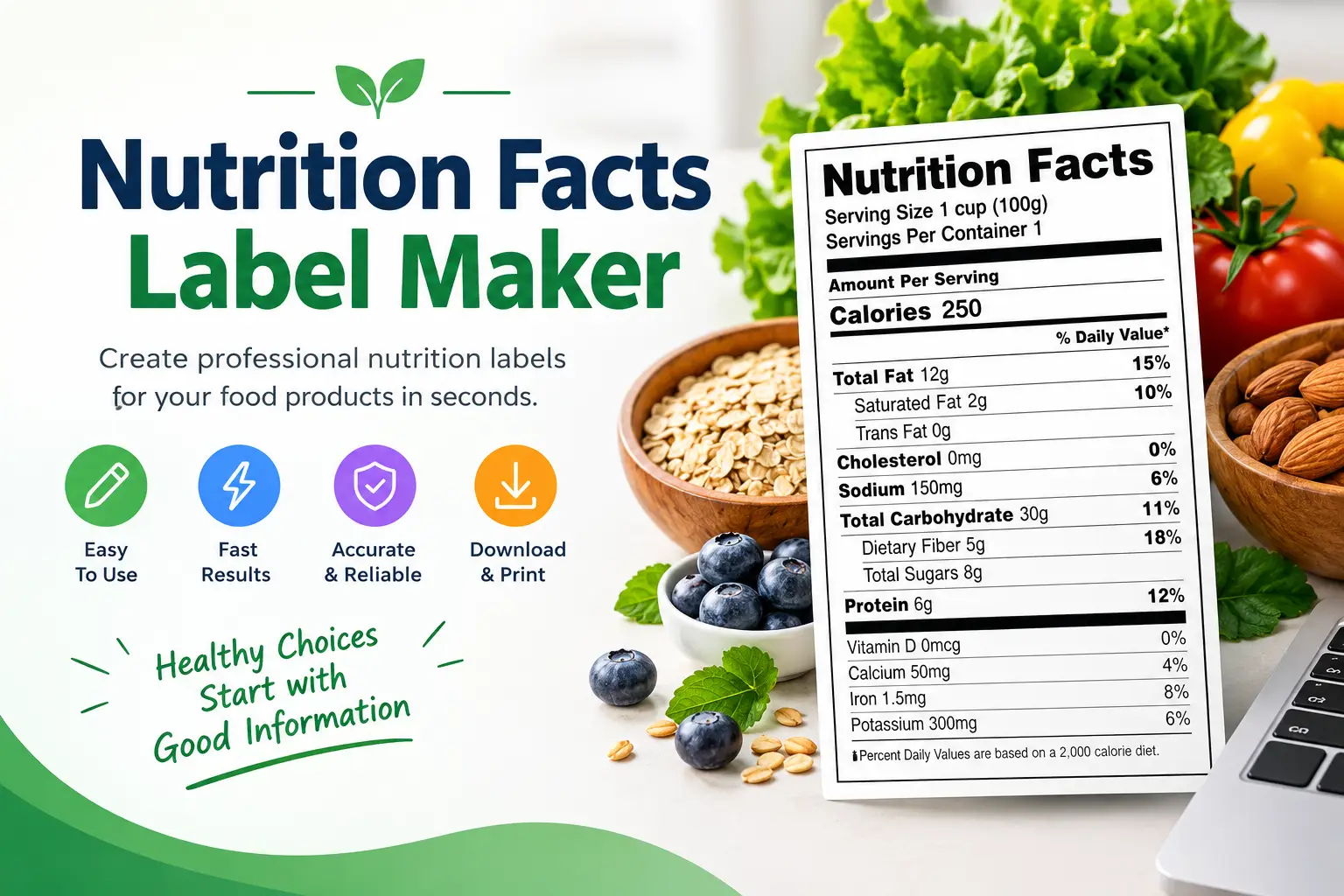
What is Nutrition facts label maker?
A nutrition facts label maker is a handy tool which allows you to generate FDA style nutrition labels for your recipes, food products or meals. Such a tool can be useful for a home cook, small food producer, or a gym-goer interested in tracking their macros.
We provide this calculator free of charge, and it is very simple to use. Just enter the basic information about your product or meal and get a nutrition label!
How to use the nutrition facts label maker
It takes only a few simple steps to create a nutrition label with our calculator:
- Enter name of recipe/product – e.g. "homemade granola" or "protein bar."
- Enter the serving size – e.g. 1 cup (30g), or 1 bar (50g).
- Enter how many servings per container.
- Enter nutritional values per serving:
1. Calories
2. Total Fat (g)
3. Saturated Fat (g) Cholesterol (mg) — Sodium (mg) — Total Carbohydrates (g)
4. Dietary Fiber (g) —Total Sugars (g) — Protein (g) – Vitamin D (mcg)
5. Calcium (mg), Iron (mg) Potassium (mg)– Vitamin A (mcg) - click btn: Generate Nutrition label
- see the preview of the generated nutrition label. You can print it or save it as PDF using the printing function
Why are nutrition facts label useful?
There are several reasons why investing time in generating a nutrition facts label is worth it:
- Nutrition facts labels inform people about what they eat – it's harder to eat badly when you know what you eat.
- Helps to track nutritional intake – the label provides the amount of kilojoules/serving and macronutrients such as carbohydrates, protein, and fats.
- Helps to adhere to special diets – people on low-carb, low-fat, or other special diet can easily see if the product is suitable for them.
- Helps to follow allergen-free diet – people who are allergic to a certain ingredient often have to prepare food themselves; however, it is still useful to label such products to indicate that they are free from certain allergens.
- Helps comply with law – if you produce and sell food items, it is compulsory to put a nutrition label on the packaging.
- Help the fitness enthusiasts track their intake of macros and calories.
What is on the nutrition facts label?
The FDA requires specific information to be present on the nutrition facts label. Here is a breakdown of what each line means:
| Description | What is it? |
|---|---|
| Serving size | Appropriate portion size |
| # of Calories | Energy provided per serving |
| Total Fat | Include saturated, unsaturated and trans fats |
| Saturated Fat | A type of fat that raises blood cholesterol levels |
| Cholesterol | Waxy substance found in animal foods |
| Sodium | Table salt |
| Total Carbohydrates | Includes dietary fiber, simple sugars and starch |
| Dietary Fiber | Indigestible part of plants |
| Total Sugars | Include both simple (glucose) and complex (starch) carbohydrates |
| Protein | Essential for tissue building and muscle growth |
Food label regulations for companies (FDA requirements)
When you are running a food production business, your product's packaging must include a nutrition facts label. Moreover, your nutrition label has to meet certain criteria set by the regulatory agencies. For reference, the most important aspects of labeling regulations are:
- Statement of identity – this describes the product; for example: 0,3% salt (reduced salt), low-fat milk;
- Net quantity of contents – the amount of food in the package;
- Nutrition facts panel – as explained above;
- Ingredient list – list of all ingredients in descending order of quantity;
- Allergen declaration – presence of any major allergens;
- Name and place of business – the name of the producer and the address
Note: This label provides information for personal use or education purposes only. When you are making a food product for sale, it is your responsibility to make sure that your dietary label is compliant with all local and international regulations.
Supplement vs nutrition facts label
The tool described above provides information regarding the nutrition facts label; however, when producing a nutritional supplement (a vitamin bar, protein shake or a sports nutrition bar), you need to follow slightly different regulations.
When creating a food product for sale, you need to provide a "statement of identity," which is basically a description of the product and its purpose. Then, you list the quantity of "active ingredients" contained in the product and other ingredients. A good example is a protein bar. According to DSHEA regulations, if you are providing a food supplement in the form of a bar, your packaging needs to include:
- Supplement facts label
- A statement of identity. e.g.: "a sports nutrition bar with 20g of protein to promote lean muscle growth."
- List of ingredients (in descending order): e.g. Soy protein concentrate, whole wheat flour, fructose, palm oil, etc.
- "Contains": list of major allergens used in the product
- "Net quantity of contents": specify the number of bars per package
- "Serving size": instruction of how to consume the product
- "Daily value (%DV)": specify the nutritional value of the product. e.g. For a protein bar, specify how many grams of protein per serving size it contains.
Understanding Added Sugars
According to the FDA, the nutritional facts label needs to specify the amount of both 'added' and 'natural' sugars contained in the product.
The 'added' category specifically refers to sweeteners that have been added to the food product, either in the form of liquid or syrup; for example: high-fructose corn syrup, lactose, maltose, saccharose, or agave nectar. The 'natural' category refers to naturally occurring sugars, such as the ones found in dairy products and fruits. When designing your own label, make sure to indicate the amount of both types of sugars.
9 Most Common Allergens in the United States and Labeling Requirements
According to FALCPA law (Food Allergen Labeling and Consumer Protection Act), the most common sources of food allergies in the U.S. are:
- Milk
- Eggs
- Fish
- Crustacean shellfish
- Tree nuts
- Peanuts
- Wheat
- Soybeans
- Sesame (as of 2023)
When making a food product for sale, you need to make a "Contains:………" statement right after the "statements of ingredients" list.
Can i use this on my cafe menu?
Using nutrition labels in restaurants is not a requirement in most countries and jurisdictions. It may apply to specific kinds of food or only if the restaurant has over 20 locations. However, a growing number of restaurant owners use nutrition labels to improve their offering and better serve their clients. If you decide to do the same, make sure that the portion size you specify in the calculator is the same as the one used in kitchens. Failure to account for differences between 'plate size' and 'serving size' will result in incorrect information on the label.
FAQs
Related tools
Related Articles
- Five Food Groups: A Complete Guide to Balanced Nutrition
- Muscle vs Fat
- Saturated vs Unsaturated Fats
- Lean Bulk Guide: How to gain muscle without fat
- Rule of Nines Burns
- Army AFT Standards