
RPE Calculator
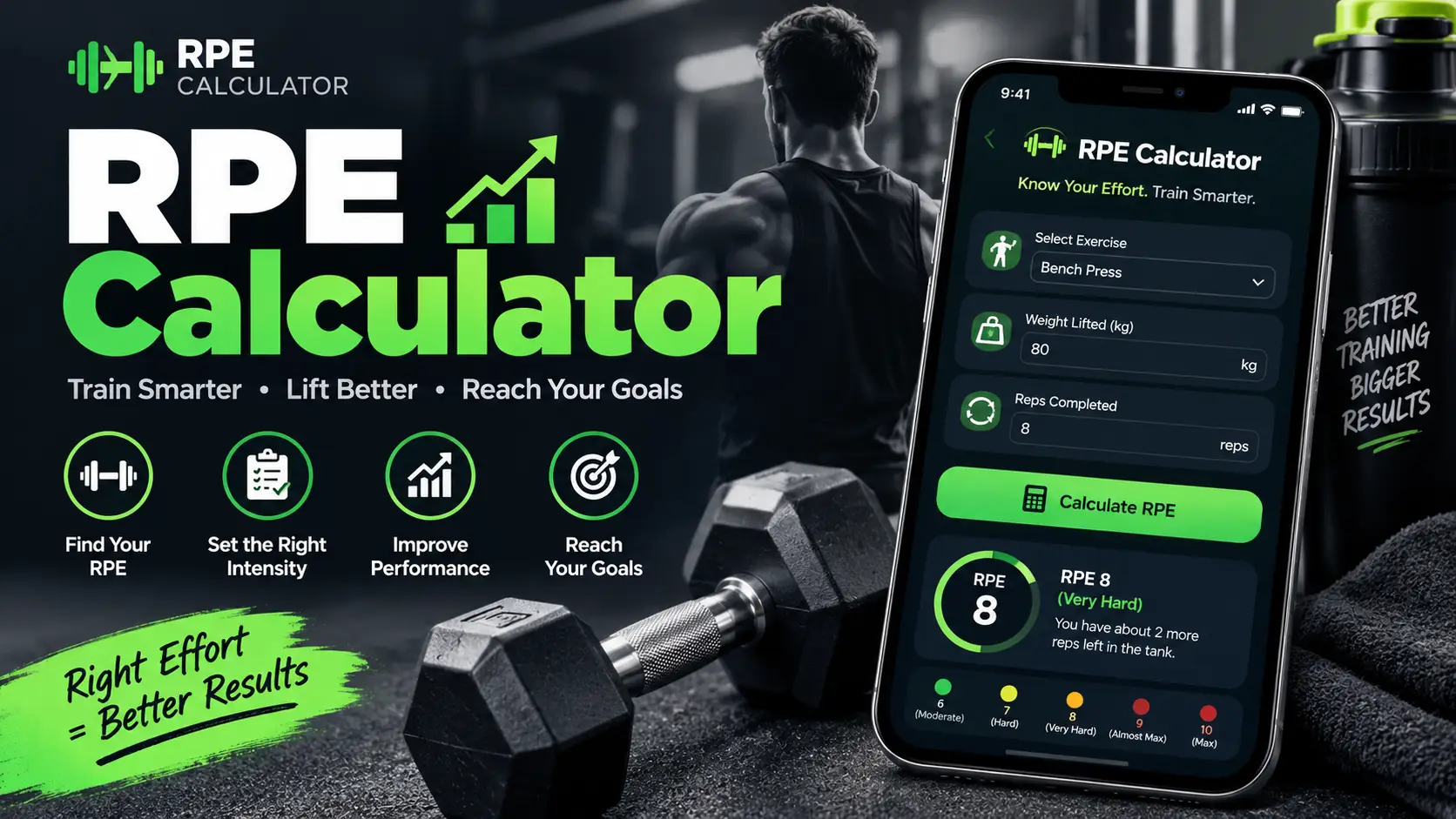
Use our RPE Calculator to estimate your training intensity and auto regulate your workouts. Use RPE (Rate of Perceived Exertion) to indicate what percentage of your max you should lift on any given day.
Estimated 1RM
What is RPE?
RPE stands for Rate of Perceived Exertion. When referring to calculating 1-RM, RPE is a method of auto regulating your working sets based on how you feel on a given day. The scale goes from 1 - 10, with 10 meaning absolute max. 1 RPE is extremely light.
How to use the RPE calculator
- Enter the weight you lifted
- Enter the reps you did
- Select the RPE (how many reps you had left)
- Click calculate to get your estimated 1RM
RPE scale explained
| RPE | Meaning | Reps left |
|---|---|---|
| 10 | Max | 0 |
| 9.5 | Maybe one more | 0-1 |
| 9 | One left | 1 |
| 8 | Two left | 2 |
| 7 | Three left | 3 |
The origin of the RPE scale: From endurance to powerlifting
The original RPE scale was created by the Swedish scientist Gunnar Borg in the 60s for endurance sport and patients with heart conditions. In the early 2000s, the powerlifting coach Mike Tuchscherer implemented the Borg scale in strength training. He used the 1-10 version of the scale and introduced the concept of "Reps In Reserve". Today, RPE is part of most training programs because it allows the lifter to train smart and listen to their body. It's all about central nervous system capacity and the ability to produce force on a daily basis.
RPE vs RIR (Reps In Reserve): What's the difference?
You may have heard of RIR when people refer to RPE. The difference is mathematical. RIR is simply the number of reps left in the tank. See the calculation below.
- RPE 10 = 0 RIR (No reps left)
- RPE 9 = 1 RIR (1 rep left)
- RPE 8 = 2 RIR (2 reps left)
Using RIR will allow you to be more precise. For example, if your coach says "do this set at RPE 8", he may as well say "leave 2 reps in the tank". The RPE calculator above uses this calculation to estimate your 1RM.
Why auto-regulation is a game-changer
Did you ever go to the gym, felt like crap because you didn't sleep well throughout the week, and failed a working set? That's the problem with percentage-based programs. If your program says to do 80% of your 1-RM and you feel like 85% that day, your set just became way heavier than you anticipated. That's also a problem when you feel amazing and ready to PR but your program says to do a lighter set.
The reason auto-regulation is so effective is that it will let you do the appropriate amount of work based on your 1-RM on that particular day. The RPE calculator will help you do that.
How to judge RPE correctly
It takes time to get a good sense of your RPE. Most beginners will feel overconfident and will rate themselves higher than they should. Here are some useful tips to judge your RPE:
- Think about your bar speed: If you're fast, you're probably at RPE 6-7. If you're grinding, you're at RPE 9-10.
- Pay attention to your form: If your form is deteriorating, you're at RPE 9 or higher, unless you're doing an isolation exercise.
- Don't go to RPE 10 (max) if you don't have a spotter: This is especially true for compound movements like the bench press and the squat. For isolation exercises, it's safer to go to RPE 10.
The importance of RPE in different phases of training
- Hypertrophy: You want to work close to failure to recruit as many motor units as possible. For hypertrophy, you'll want to stay in the 8-9 RPE range.
- Strength: For strength gains, you want to move heavy weights with perfect form. You'll mostly be in the 7-8 RPE range with some sets in the 9-10 range ("tapers").
- Deload: This is the time to lower the overall volume while keeping the intensity. A good deload week would be in the 5-6 RPE range.